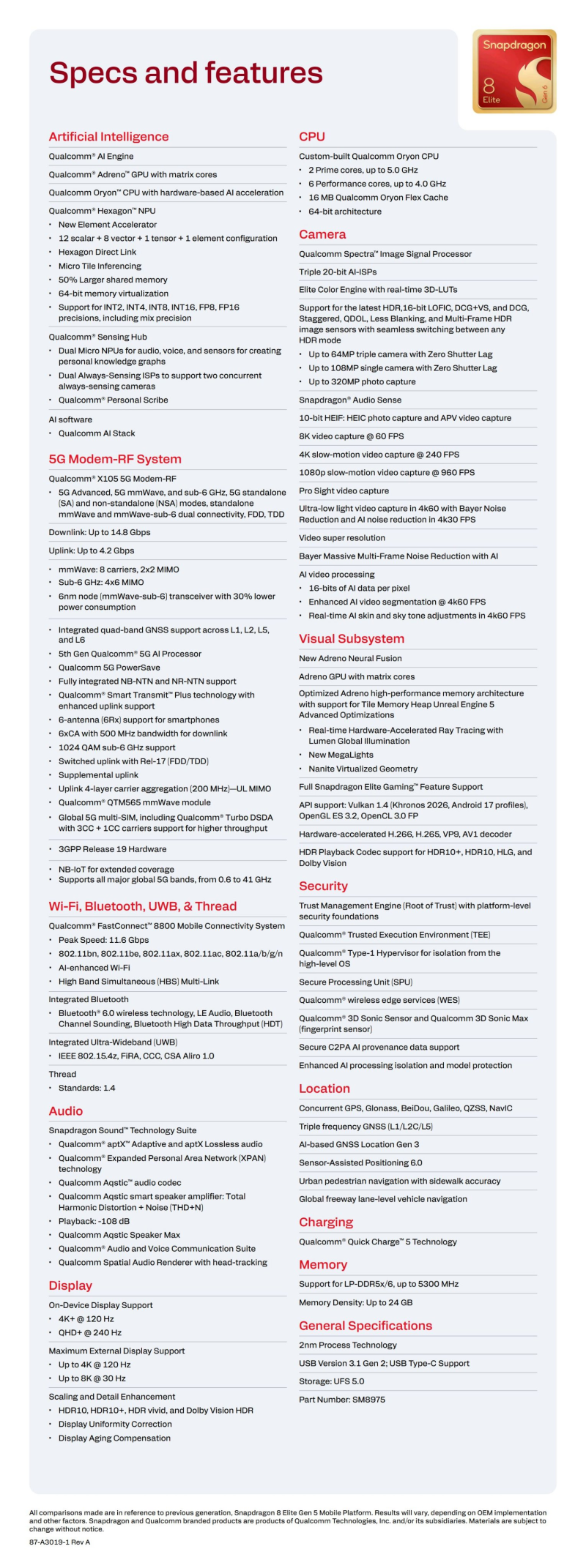
Compared with Snapdragon 8 Elite Gen 5, Qualcomm claims 13% higher CPU performance and 37% better CPU efficiency, 44% faster graphics, and 35% higher NPU performance.
5GHz Oryon CPU
The custom 64-bit Oryon CPU uses an eight-core configuration:
- 2× Prime cores: up to 5.0GHz
- 6× Performance cores: up to 4.0GHz
- 16MB Oryon Flex Cache
- 2nm process
| CPU | Snapdragon 8 Elite Extreme Gen 6 | vs. Elite Gen 5 |
| Prime clock | 5.0GHz | Higher |
| Performance clock | 4.0GHz | Higher |
| CPU performance | — | +13% |
| CPU efficiency | — | +37% |
Sustained 5GHz performance will depend on each smartphone's cooling and power limits.
Adreno GPU: +44% Performance
The new Adreno GPU adds dedicated matrix cores and Qualcomm's Adreno Neural Fusion architecture.
Qualcomm claims 44% higher GPU performance and 40% better efficiency versus Gen 5. The GPU slices run at up to 1.45GHz, backed by 18MB of Adreno High Performance Memory.
Unreal Engine 5 support includes:
- hardware-accelerated ray tracing
- Lumen Global Illumination
- MegaLights
- Nanite Virtualized Geometry
Neural Fusion enables AI-assisted super resolution and frame generation. Diablo Immortal and War Thunder Mobile are among the first announced implementations.
The graphics APIs are Vulkan 1.4, OpenGL ES 3.2 & OpenCL 3.0 FP. The hardware decodes H.266, H.265, VP9 & AV1 video formats.
Hexagon NPU: 30B+ Models On-Device
The new Hexagon NPU uses a 12 scalar + 8 vector + 1 tensor + 1 element configuration with a new Element Accelerator.
Compared with Gen 5:
| AI | Improvement |
| NPU performance | +35% |
| Shared memory | +50% |
| AI performance/watt | +33% |
The NPU supports INT2, INT4, INT8, INT16, FP8 and FP16, including mixed-precision inference, Micro Tile Inferencing and Hexagon Direct Link.
Qualcomm says the platform can run 30B+ parameter models locally, subject to model quantization and available memory. The Sensing Hub adds dual Micro NPUs for persistent audio, voice and sensor processing, plus dual always-sensing ISPs for two concurrent always-on cameras.
Triple 20-bit AI ISP
The Snapdragon Spectra subsystem uses three 20-bit AI ISPs.
Camera support includes:
- up to 320MP photos
- 108MP single-camera Zero Shutter Lag
- 64MP triple-camera Zero Shutter Lag
- 10-bit HEIF
- 16-bit LOFIC, DCG+VS, DCG, Staggered, QDOL and Multi-Frame HDR
Video reaches 8K 60 FPS, 4K 240 FPS slow motion and 1080p 960 FPS slow motion. AI video processing includes 4K60 segmentation and real-time skin/sky tone adjustment, plus Bayer multi-frame noise reduction, video super resolution and AI noise reduction.
Memory and Storage
The memory controller supports:
- LPDDR5X / LPDDR6
- up to 5300MHz
- up to 24GB RAM
- UFS 5.0
- USB 3.1 Gen 2 / USB-C
The move to LPDDR6 and larger memory configurations is particularly relevant for local LLM and multimodal workloads.
X105 5G Modem
The integrated Snapdragon X105 supports 5G Advanced, mmWave, sub-6GHz, SA/NSA and 3GPP Release 19 hardware.
| X105 | Specification |
| Peak downlink | 14.8Gbps |
| Peak uplink | 4.2Gbps |
| mmWave | 8 carriers, 2×2 MIMO |
| Sub-6GHz | 4×6 MIMO |
| Downlink aggregation | 6×CA, 500MHz |
| Modulation | 1024-QAM |
The 6nm mmWave/sub-6 transceiver is rated for 30% lower power consumption. Integrated NB-NTN and NR-NTN provide satellite connectivity support.
Wi-Fi 8 and Bluetooth 6.0
The FastConnect 8800 subsystem reaches a claimed 11.6Gbps peak Wi-Fi speed.
It supports:
- Wi-Fi 8 / 802.11bn
- Wi-Fi 7 / 802.11be
- AI-enhanced Wi-Fi
- High Band Simultaneous Multi-Link
- Bluetooth 6.0
- Bluetooth Channel Sounding
- LE Audio
- UWB
- Thread 1.4
Display
On-device display support reaches:
- 4K+ at 120Hz
- QHD+ at 240Hz
External output supports 4K 120Hz or 8K 30Hz. HDR formats include HDR10, HDR10+, HDR Vivid and Dolby Vision.
Audio, Security and GNSS
Snapdragon Sound includes aptX Adaptive, aptX Lossless, XPAN, Aqstic audio and spatial audio with head tracking.
Security hardware includes the Secure Processing Unit, Trusted Execution Environment, Type-1 Hypervisor and hardware Root of Trust, plus C2PA provenance support and dedicated AI model protection.
Location uses triple-frequency L1/L2C/L5 GNSS with GPS, GLONASS, BeiDou, Galileo, QZSS and NavIC. Qualcomm also includes AI-based GNSS Location Gen 3 and Sensor-Assisted Positioning 6.0.
Gen 6 vs. Gen 5
The largest claimed generational gains are:
| Area | Snapdragon 8 Elite Extreme Gen 6 |
| CPU | +13% performance, +37% efficiency |
| GPU | +44% performance, +40% efficiency |
| NPU | +35% performance, +33% perf/W |
| NPU memory | +50% |
| RAM | LPDDR6, up to 24GB |
| Storage | UFS 5.0 |
| Video | 8K60 / 4K240 |
| Wi-Fi | Wi-Fi 8, 11.6Gbps |
| 5G | X105, 14.8Gbps, Release 19 |
For Developers
The SM8975 distributes workloads across several dedicated compute blocks:
The Oryon CPU processes general tasks and data that requires a fast response. The Adreno GPU manages images plus calculations that happen at the same time. The Adreno matrix cores increase the resolution of images and create new frames using a network of digital neurons. The Hexagon NPU performs logical steps for large language models, sight but also data from multiple sources. The Sensing Hub is an artificial intelligence that stays active while using a small amount of electricity. The Spectra ISP handles the math for taking photos and uses artificial intelligence to create video as the camera records.
For game development, the main additions are Adreno Neural Fusion, matrix cores, Lumen, Nanite and MegaLights. For local AI, the key upgrades are INT2 support, 50% more NPU shared memory, LPDDR6, up to 24GB RAM and support for 30B+ parameter models.
Motorola is the first confirmed partner with the Signature 27. Xiaomi 18 Pro and Pro Max, Vivo, Oppo, Honor, OnePlus, Redmi, RedMagic, iQOO, Nubia and ZTE are also expected to use the platform.