It uses 3D-printed TPU structures with embedded permanent magnets. Contact deforms the structure, moves the magnets relative to magnetometers underneath, and produces measurable magnetic-field changes.
The basic setup requires:
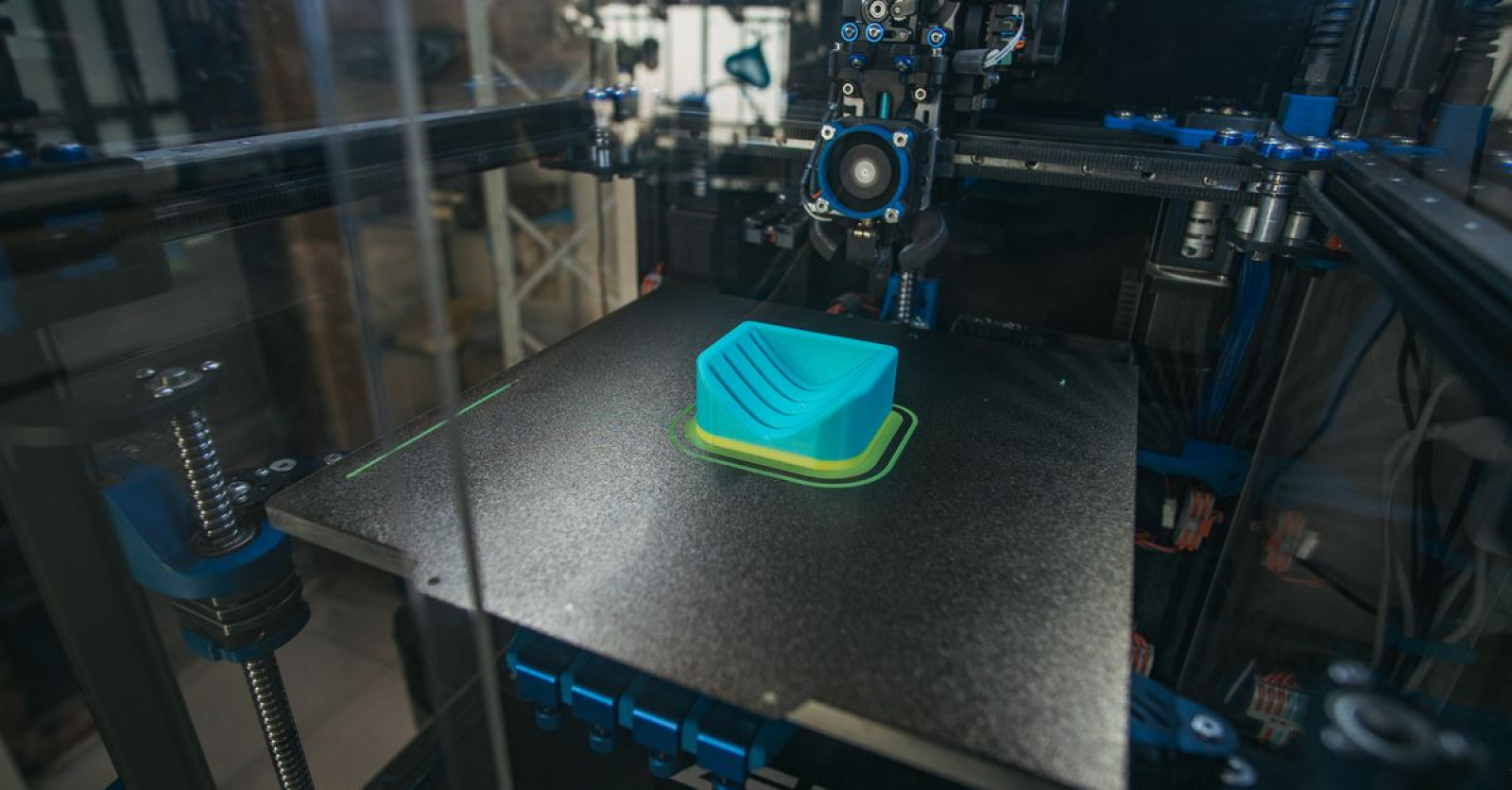
- an FDM 3D printer;
- permanent magnets costing less than $5;
- an OBJ/STL model;
- a magnetometer circuit board.
eFlesh can be adapted to fingertips, grippers, robotic hands and quadruped feet.
How eFlesh works
The sensing chain is:
contact force → deformation → magnet displacement → magnetic-field change → magnetometer data
Software maps the readings to contact position, normal force, shear force and slip state.
The sensor uses parameterized cut-cell microstructures. Their geometry determines stiffness and sensitivity.
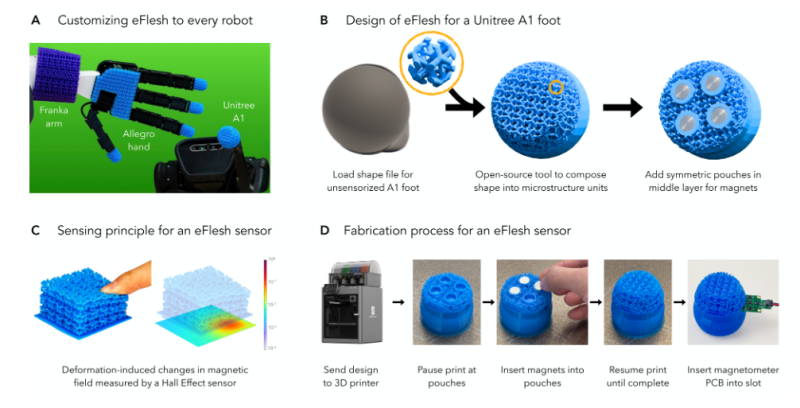
Figure 1. eFlesh workflow: adaptation to different robots, conversion of a Unitree A1 foot into a microstructured sensor, magnetic sensing through deformation, and fabrication with embedded magnets.
The Unitree A1 example shows the process:
Load robot geometry → Generate microstructure → Create magnet pockets → Start TPU print → Pause and insert magnets → Resume printing → Install magnetometer PCB
Technical specifications
| Specificatione | Flesh |
| Sensing principle | Magnetic displacement |
| Contact localization RMSE | 0.5 mm |
| Normal-force RMSE | 0.27 N |
| Shear-force RMSE | 0.12 N |
| Slip detection | 95% accuracy on unseen objects |
| Manipulation success | ~90–91% |
| Gain over vision-only | 40% |
| Material | TPU 95A |
| Magnets | N52 neodymium |
| Standard magnet size | 3/8" × 1/8" |
| Fingertip magnet size | 3/16" × 1/16" |
| Input | Convex OBJ/STL |
| Output | Printable STL |
| Software | Open source |
The reference implementation uses TPU 95A and N52 magnets. Standard sensors use 3/8 × 1/8-inch magnets; fingertip versions use 3/16 × 1/16-inch magnets.
Electronics
The electronics are separate from the printed tactile surface. The reference design uses magnetometer PCBs derived from ReSkin and AnySkin, with an Adafruit QT Py as the interface controller. The printed surface can therefore be replaced without replacing the electronics.
From CAD model to tactile sensor
eFlesh includes an open-source tool that converts a convex OBJ or STL model into a printable tactile structure.
OBJ / STL → Microstructure generator → Cut-cell structure → Magnet pockets → Printable STL
The software has been tested on Ubuntu 20.04, 22.04 and 24.04.
Main dependencies:
- CGAL;
- Eigen;
- SuiteSparse;
- Boost;
- GMP;
- MPFR.
Machine-learning pipeline
Magnetometer readings are mapped to physical quantities using learned models. For characterization, the project uses a two-layer MLP with 128 nodes.
Released models and datasets cover:
- contact localization;
- normal force;
- shear force;
- slip detection;
- visuotactile manipulation.
95% slip detection on unseen objects
Slip detection was tested on a Hello Robot Stretch. Objects were grasped and pulled to generate slip events. The classifier achieved 95% accuracy on previously unseen objects.
Vision + touch beats vision alone
eFlesh was also tested in visuotactile manipulation. The tactile-enabled policies achieved about 90% success and outperformed vision-only baselines by 40%.
Test tasks included:
- Plug insertion. Tactile data helps detect contact and alignment.
- Credit-card swiping. Contact sensing helps maintain correct engagement with the slot.
eFlesh vs AnySkin
eFlesh follows AnySkin, an earlier magnetic tactile sensor from several of the same researchers.
AnySkin focused on replaceability and cross-sensor generalization. eFlesh focuses on custom 3D geometry.
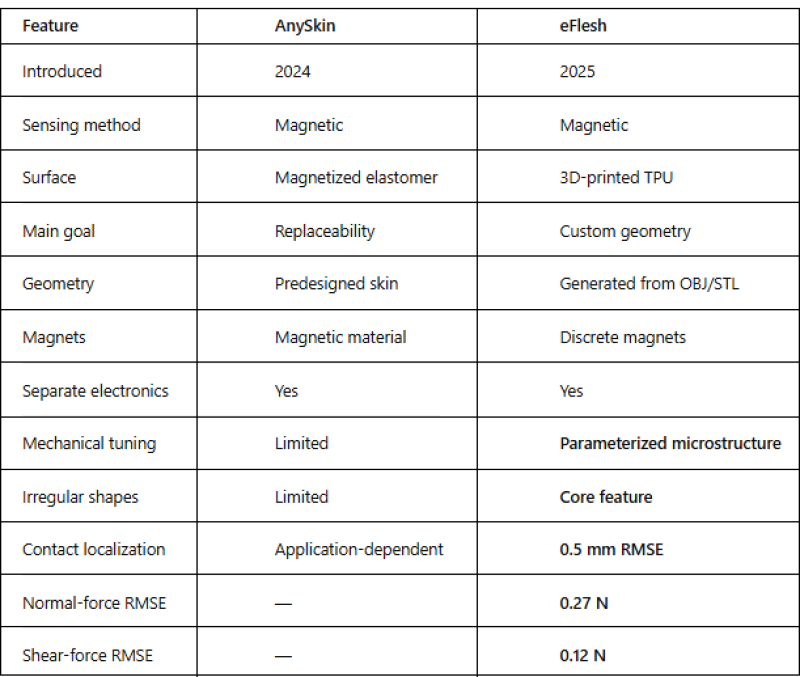
The main difference is that eFlesh generates the tactile structure around the robot component itself.
Compared with ReSkin
ReSkin is an earlier magnetic tactile sensor in the same research lineage. It used a replaceable magnetized elastomer over magnetometer electronics.
Reported specifications included:
- 2–3 mm thickness;
- more than 50,000 interactions;
- up to 400 Hz sampling;
- about 1 mm spatial resolution at 90% accuracy;
- below $6 per skin at 100-unit volumes.
The progression is:
ReSkin replaceable magnetic skin → AnySkin cross-sensor generalization → eFlesh custom 3D geometry
The "$5 sensor" claim needs context
The "$5 sensor" description is not the full bill of materials. The paper states that the magnets cost less than $5.
The complete sensor also requires:
- TPU;
- printer access;
- magnetometer PCB;
- interface electronics;
- wiring and mounting parts.
What developers actually get
The open-source repository includes:
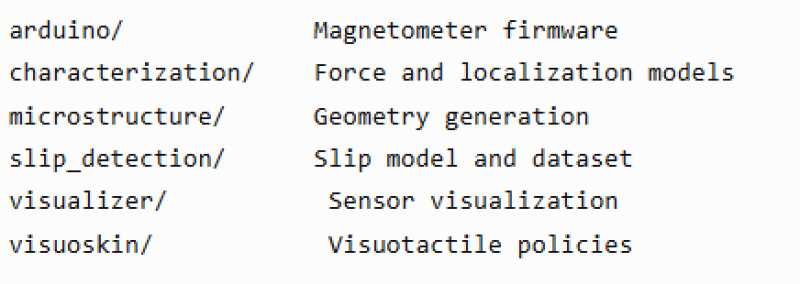
It also includes CAD files, datasets, trained models and fabrication resources.
Why eFlesh matters
eFlesh combines:
FDM printing + configurable microstructures + embedded magnets + reusable magnetometer electronics + open CAD tooling.
The key difference is simple: the sensor is designed around the robot geometry, not the robot around the sensor.