
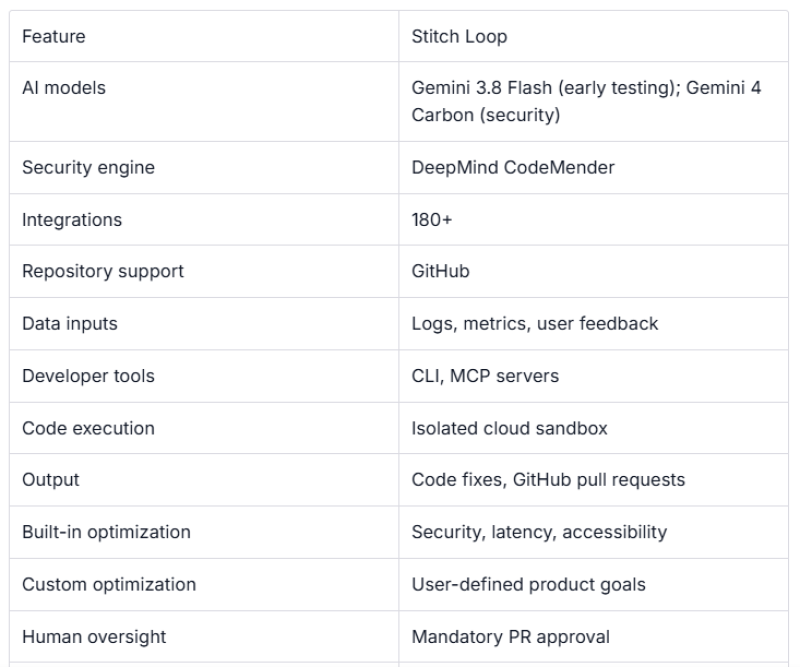
An early version reportedly used Gemini 3.8 Flash, while the new security workflow incorporates Gemini 4 Carbon and DeepMind CodeMender.
How Stitch Loop Works
Loop operates through four stages:
- Suggestions: Analyzes production logs, user behavior, and feedback to identify issues.
- Solutions: Proposes improvements and evaluates implementation options.
- Build: Generates code in isolated cloud sandboxes and creates GitHub pull requests.
- Reflect: Tracks production metrics and recommends further improvements.
Code changes require human approval before merging.
Read more:

Technical Specifications
Stitch Loop vs. Previous Stitch
| Feature | Previous Stitch | Stitch Loop |
| Primary function | UI design and prototyping | Autonomous product optimization |
| Workflow | User-directed | Continuous, goal-driven |
| Code generation | Frontend code | Production code fixes |
| Production monitoring | No built-in continuous monitoring | Yes |
| GitHub PR generation | Not a core feature | Yes |
| Security optimization | Not a core feature | Gemini 4 Carbon + CodeMender |
Gemini 3.8 Flash vs. Gemini 4
Early Loop testing reportedly used Gemini 3.8 Flash. Google's announcement confirms Gemini 4 Carbon for security analysis, but does not establish that the newer model powers every Loop function.
No direct performance benchmarks, task success rates, token costs, or execution-speed comparisons have been published.
Availability
Stitch Loop launched as a Google Labs experiment with a global waitlist and priority access for eligible Google AI Ultra subscribers.
Google has not disclosed pricing, execution limits, or production reliability benchmarks.