
It expands coding capabilities to video, game development, 3D shaders, and CAD modeling while introducing vision support.
Technical Specifications
| Specification | GLM-5.4 |
| Architecture | Loop Transformer |
| Base model | GLM-5 |
| Model scale | ~750B parameters |
| Looped layers | 28 |
| Loop iterations | 2 |
| Attention | Sparse attention with index reuse |
| KV cache | Shared cache + independent sliding window |
| Modalities | Text and vision |
| API availability | Pending safety evaluation |
| Model weights | Planned responsible release |
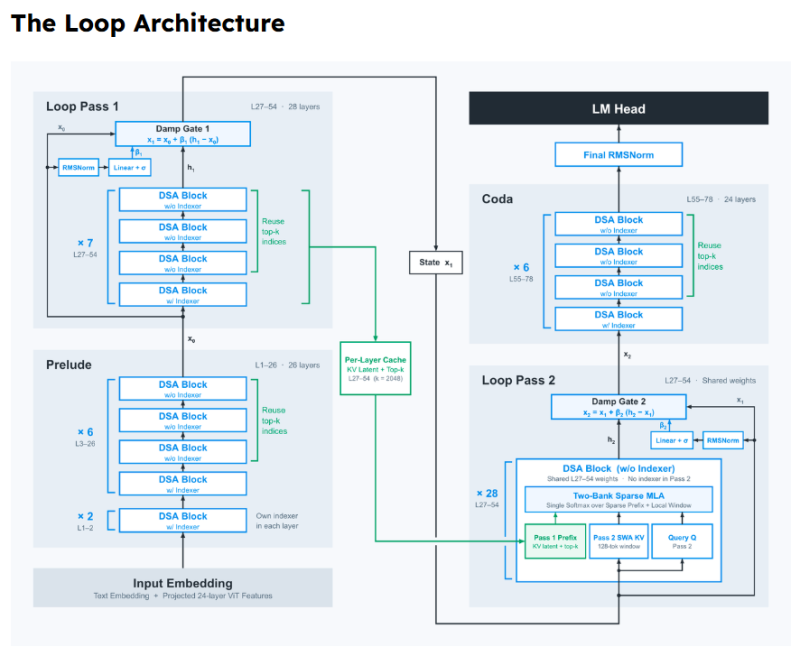
The Loop Transformer processes selected layers twice using shared weights, increasing computational depth without duplicating model parameters.
Its architecture includes gated progressive updates, KV-cache reuse, and sparse attention index sharing to reduce memory and computation overhead.
GLM-5.4 vs. GLM-5.3
| Feature | GLM-5.3 | GLM-5.4 |
| Architecture | Conventional Transformer | Loop Transformer |
| Layer execution | Single pass | Two iterations over 28 layers |
| Vision support | No | Yes |
| Coding focus | Software engineering, agents | Software, games, video, CAD, 3D shaders |
| Published coding benchmarks | Available | Not yet available |
| Coding Plan quota | Baseline | +50% weekly allowance |
GLM-5.3 benchmark results:
- Terminal Bench 2.1: 88.2
- DeepSWE v1.1: 66.9
- CyberGym: 84.5%
Comparable GLM-5.4 results have not been disclosed.

Expanded Coding Capabilities
Z.ai demonstrated GLM-5.4 generating:
- Video: A self-narrated music video.
- CAD: A six-axis robotic arm modeled in FreeCAD.
- Games: Movement, physics, maps, combat systems, and assets.
- 3D graphics: Interactive scenes using GLSL shaders.
These are code-driven generation workflows, not evidence of native video or 3D asset generation.
Availability
GLM-5.4 is accessible through Z.ai's existing coding and chat products. Public API access remains subject to safety evaluation, while model weights are scheduled for a responsible release.
GLM-5.4 introduces iterative layer reuse and vision-enabled coding. Its performance advantage over GLM-5.3 remains unverified until comparable benchmarks are published.