Agents can request premium company, SEO, social media and financial data without maintaining separate subscriptions with each provider. They can inspect a price before placing a request and track the charge afterward.
Technical specifications
| Specification | Details |
| Endpoint catalog | 2,000+ paid endpoints (reported) |
| Providers | 80+ (reported) |
| Billing | Pay-per-call, using a shared prepaid balance |
| Authentication | Single workspace API key |
| Integration | MCP, CLI and HTTP API |
| Supported data | SEO, corporate records, people, social media and financial metrics |
| Cost visibility | Price inspection before execution; charge reporting afterward |
| Request controls | Execution status and idempotency keys |
Note: The Glasser homepage has also advertised 1,700+ tools and APIs. The 2,000+ figure comes from the supplied launch report and should not be mistaken for an audited live endpoint count.
What changed from the earlier rollout
| Metric | September 2026 | October 2026 reported |
| Endpoints | Approximately 1,500 | More than 2,000 |
| Providers | 29 | More than 80 |
| Billing | Per API call | Per API call |
| Agent access | MCP, CLI, HTTP API | MCP, CLI, HTTP API |
The reported catalog change is roughly 33% growth in endpoints and more than 175% in providers. This is a comparison with a previous service rollout, not an AI model benchmark.

API selection and execution
1. Search the catalog for data matching the task.
2. Inspect the endpoint schema, available parameters and quoted cost.
3. Compare competing data sources when equivalent lookups are offered.
4. Execute the selected endpoint and receive the result.
5. Record execution status and actual billing amount.
Glasser documents operations including search, inspect, run, runs_get, runs_list, runs_stop and balance. Idempotency keys reduce the risk of repeated billing for duplicate execution attempts. Endpoint-level billing conditions still apply.
Subscription vs. pay-per-call economics
The supplied comparison illustrates what the same amount of spend could purchase under advertised subscription prices and example Glasser API-call rates. The chart is inserted below in place of the earlier Ahrefs-only visualization.
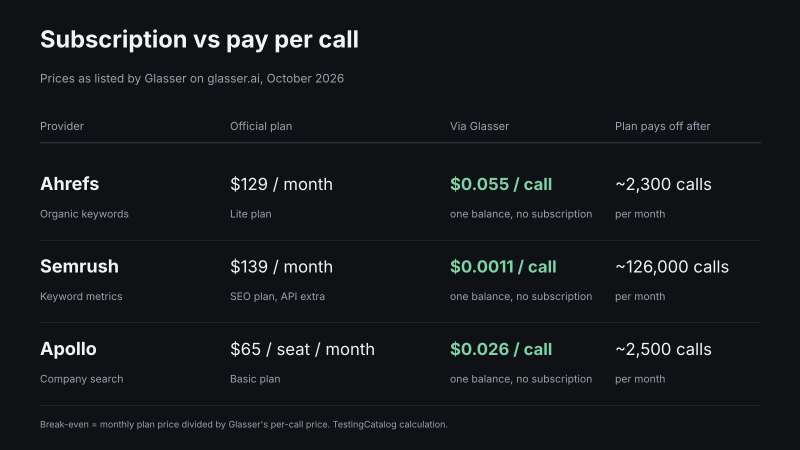
Figure 1. Subscription vs pay per call: Ahrefs, Semrush and Apollo. Prices listed by Glasser; October 2026. Image supplied by the user.
The indicated break-even estimates are about 2,345 Ahrefs calls ($129 ÷ $0.055), 126,364 Semrush calls ($139 ÷ $0.0011) and 2,500 Apollo calls ($65 ÷ $0.026). These are arithmetic comparisons—not a claim that the plans and individual API calls provide identical data access or entitlements.
Operational limitations
- Data quality depends on the underlying third-party providers.
- The cost of empty results and failed requests can vary by endpoint.
- High-volume automated workflows can still incur substantial cumulative charges.
- Provider licensing and redistribution rules may limit downstream reuse.
- No independently verified platform-wide latency or uptime figure is established here.
Conclusion
Glasser’s distinguishing feature is unified, usage-based access to commercial data across providers. Agent-side price discovery and per-request billing could simplify sporadic cross-provider research. Heavy users should compare total costs and actual API entitlements against direct contracts rather than treating the displayed break-even figures as equivalent-service guarantees.
Sources