An open-source inference engine, kimi-k3-in-c v2.0.0, runs Moonshot AI's 2.78-trillion-parameter Kimi K3 model without a GPU. The engine consists of just 176 KB of portable C99 code and requires as little as 8.24 GB of RAM.
A full 16-bit model would require 5.56 TB of memory. Instead, the engine streams model weights from NVMe storage and performs calculations directly on packed 4-bit weights.
Technical Specifications
| Specification | Value |
| Model parameters | 2.78 trillion |
| Active parameters per token | 104 billion |
| Architecture | Mixture-of-Experts (MoE) |
| Routed experts per layer | 896 |
| Selected experts per token | 16 |
| Quantization | MXFP4 (4-bit) |
| Checkpoint size | 1.56 TB |
| Minimum measured RAM | 8.24 GB |
| Inference engine | 176 KB, C99 |
| GPU requirement | None |
| Platforms | Linux, macOS, Windows |
Kimi K3 activates only 16 of its 896 routed experts per layer for each token. The engine retains essential components in RAM and retrieves the selected experts from disk, allowing approximately 93% of the checkpoint to remain on storage.
CPU Inference Benchmarks
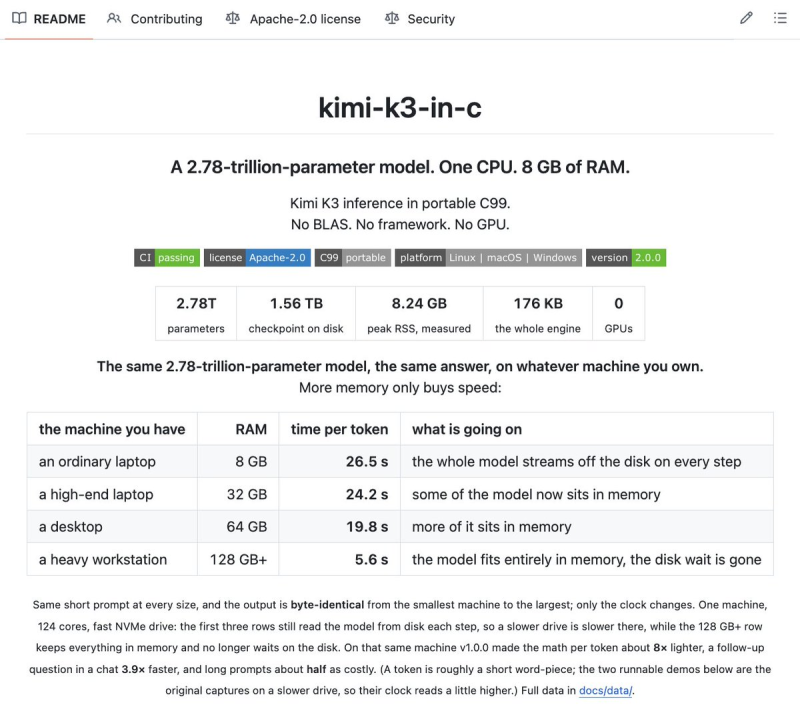
Benchmarks used the same prompt on a 124-core machine with fast NVMe storage. Outputs were byte-identical across configurations.
Increasing RAM from 8 GB to 128 GB+ improved generation speed by 4.7×.
Version 2.0.0 also reports improvements over v1.0.0:
- ~8× less computation per token.
- 3.9× faster follow-up chat questions.
- ~50% lower processing cost for long prompts.
Kimi K3 vs. Kimi K2
| Specification | Kimi K2 | Kimi K3 |
| Total parameters | 1T | 2.78T |
| Active parameters | 32B | 104B |
| Transformer layers | 61 | 93 |
| Routed experts | 384 | 896 |
| Selected experts | 8 | 16 |
| Context window | 128K | ~1M |
| Attention | MLA | KDA + Gated MLA |
Kimi K3 has 2.78× more total parameters and 3.25× more active parameters than K2.
Hardware Requirements and Limitations
Despite its low RAM requirements, the engine still needs approximately 1.7 TB of free disk space.
At 8 GB RAM, generating 100 tokens takes roughly 44 minutes. With 128 GB+ RAM, the same output takes approximately 9.3 minutes, excluding processing overhead.
The implementation demonstrates memory-efficient CPU inference, but its latency remains unsuitable for most interactive applications.
The result: A 2.78T-parameter model can generate text without a GPU or terabytes of RAM, trading inference speed for lower memory requirements.